
Your Hotel Should Look Like
Nothing Else in the Market.
Most hotels in any given market share the same three aesthetic languages. That is why many hotel renovations fail to lift ADR — the underlying concept and market position were never resolved before the design work began. BrandClave applies demand intelligence and spatial positioning to define what your hotel should look like, feel like, and function like — before architects and interior designers begin. Not a mood board. A market-validated design direction.
What Is AI Hotel Design?
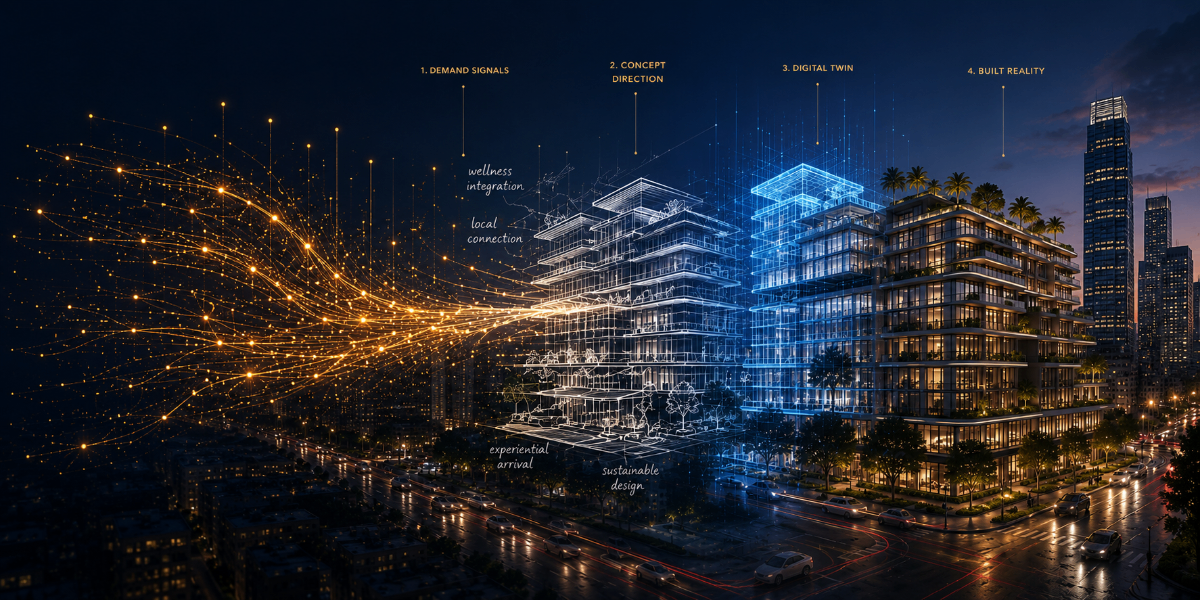
AI hotel design is the application of demand intelligence and spatial positioning to define a hotel's visual and experiential identity — its spatial character, material language, facade logic, guest journey, and environmental atmosphere — before architects or interior designers begin. Unlike generative AI that produces images from text prompts, BrandClave's AI hotel design reads live market signals to determine what spatial identity the market is missing, then translates that intelligence into a commercially resolved design brief that design teams execute with confidence.
Why Pay for AI Hotel Design If You Can Use ChatGPT?
ChatGPT can generate ideas. It cannot determine what hotel concept should exist in a specific market, what demand is underserved, what positioning can command a premium, or how an asset should be structured to outperform surrounding supply.
ChatGPT / Midjourney / Generic AI
- Generates images from text prompts
- No market validation
- No competitive analysis
- No material specification
- Beautiful but commercially blind
BrandClave AI Hotel Design
- Reads live market demand signals
- Validates spatial identity against competitive supply
- Specifies material, facade, and experiential logic
- Delivers a pre-architecture brief architects build from
- Every decision traces to revenue opportunity
That is the difference between AI as a tool and BrandClave as a development intelligence system. The outcome is not generic AI-generated imagery. It is a commercially grounded hotel concept designed around market opportunity, guest behavior, long-term differentiation, and revenue potential.
What BrandClave Creates
Unlike interior designers who execute spatial decisions, BrandClave determines what those decisions should be — based on verified market demand, not subjective taste or trend reports. Every deliverable traces to a revenue outcome.
Hotel Demand Signal Analysis
Read live market signals for your specific location and category — what hotel experiences guests are searching for, what design languages command premiums, where competitive supply is concentrated, and where genuine spatial differentiation gaps exist.
Hotel Concept & Spatial Positioning
Define what your hotel should be: the spatial identity, the guest promise, the experiential territory. We determine the precise design direction that captures unmet demand — not a mood board assembled from Pinterest.
Material Identity & Palette Direction
Resolve the material language that communicates your hotel concept — stone, wood, metal, textile, lighting — each selection traced to a demand signal and a competitive differentiation objective.
Facade Logic & Architectural Character
Define the exterior identity: massing principles, facade rhythm, material hierarchy, and how the building communicates its concept before a guest walks through the door.
Guest Experience Architecture
Sequence the physical journey from arrival through departure — lobby, corridors, rooms, F&B, amenity spaces — each transition designed to reinforce the concept and drive guest satisfaction and spend.
AI Hotel Visualization & Digital Twin
Translate hotel strategy into AI-generated concept visualizations and walkable digital twin environments. Stakeholders and architects align around a shared visual reference before design begins.
Competitive Spatial Audit
Identify what design languages competitors have already claimed and where visual white space exists. Most hotel markets are saturated with the same three aesthetic languages. We find the one no one has taken.
Pre-Architecture Design Brief
Deliver the complete strategic foundation architects need: market-validated concept, spatial identity, material direction, facade logic, experiential framework, and revenue-aligned design principles.
What You Receive
Where AI Hotel Design Applies


Works Alongside Your Design Team
Not a replacement for architects or interior designers. A strategic front-end that makes their work stronger and more commercially confident.
Strategic Foundation Only
We deliver spatial direction and design principles, not construction documents. Your architects and designers own the execution.
Project-Based Engagement
No retainer. No long-term lock-in. Defined scope, defined timeline, defined deliverables. Demand analysis in 2 days, everything else in 2 weeks.
Eliminates Design Indecision
When designers start with a resolved spatial brief, fewer rounds of revision. Faster to construction documentation.
Before Your Architects Begin,
Define What Your Hotel Should Look Like.
Every week a hotel project spends without a resolved spatial brief costs money in design revision cycles, delayed construction starts, and missed market windows. A market-validated spatial identity helps a hotel stand apart from comparable properties that rely on generic design. BrandClave determines what your hotel should look like, feel like, and function like — before a single floor plan is drawn. Demand analysis in 2 days. Complete design direction in 2 weeks.
Frequently Asked Questions
Does AI hotel design replace architects?
No. AI hotel design replaces the blank page architects traditionally receive. Instead of starting with an undefined brief, architects receive a commercially resolved spatial identity, material direction, facade logic, and experiential framework. AI hotel design gives architects more clarity, not less — and the creative freedom to execute within a defined strategic foundation.
How long does AI hotel design take?
The hotel demand analysis is delivered in 2 days. The remaining seven deliverables — spatial concept, material identity, facade logic, guest experience architecture, competitive audit, AI visualizations, and the pre-architecture design brief — are all delivered together in a single 2-week sprint. This replaces what traditionally requires multiple design consultants over several months.
Can AI hotel design work for adaptive reuse and repositioning projects?
Yes. AI hotel design is especially valuable for adaptive reuse and repositioning, where existing structure constrains spatial possibility and demand intelligence becomes even more critical. BrandClave reads the market opportunity for the specific site and building, then defines the spatial identity and experiential direction that will differentiate the repositioned asset.
What is the relationship between AI hotel design and AI hotel branding?
AI hotel design and AI hotel branding are integrated at BrandClave. The market intelligence that drives spatial identity directly informs brand positioning, visual identity, and guest promise. The spatial brief and brand brief are developed simultaneously — ensuring that what the hotel looks like, what it feels like, and what it communicates are all aligned with the same demand signals.
Who should use AI hotel design?
AI hotel design is for hotel developers, hotel investors, boutique hotel founders, adaptive reuse developers, wellness hospitality developers, branded residence developers, mixed-use developers, and anyone building a hotel where spatial identity determines market performance. If your hotel will compete on experience rather than price, AI hotel design provides the intelligence foundation.
What is the difference between AI hotel design and hiring an interior designer?
Interior designers execute spatial decisions. AI hotel design determines what those decisions should be — based on market demand, competitive positioning, and revenue architecture. Interior designers start with a client brief. BrandClave writes that brief from live market intelligence, giving designers a commercially validated creative foundation rather than subjective preference.